
Guide / Certificate check
Is this FloorScore certificate real? How to check scope, product and plant
Check a FloorScore certificate in five steps: registration number, holder, plant, product scope and dates with SCS, plus what FloorScore does not prove.
Short answer
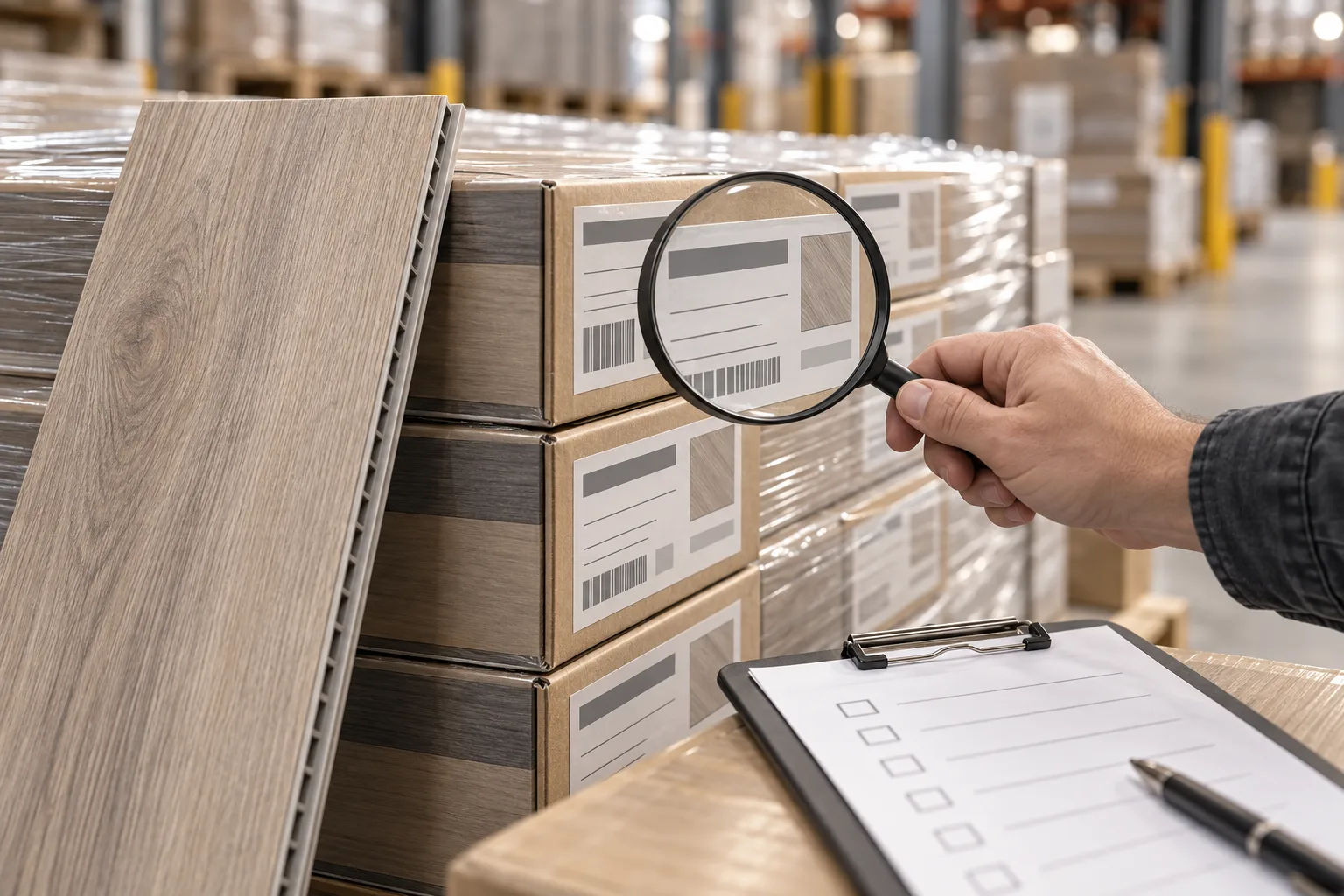
A FloorScore certificate supports your order only when the SCS listing shows the same number, holder, plant and product scope as your PDF, your exact construction and total thickness sit inside that scope, and the dates cover production. Forged files are the smaller risk. A genuine certificate for another plant or a thinner board is the common one, so name the plant in your contract.
The common failure is not a fake PDF. It is a real certificate for a different plant, holder or thickness.
Plant mismatch matters most: it can mean your floor is made somewhere else. Treat it as a stop until explained in writing.
Write the certificate number, plant address and thickness limit into the contract, and re-check at order, before carton print and before shipment.
What is the real risk with a FloorScore certificate?
You already know what FloorScore is: the RFCI indoor-air emissions certificate, issued by SCS Global Services and tested to the CDPH Standard Method. That part is easy. The hard part is that a certificate covers named products, from a named holder, at a named address, within stated thickness limits, for stated dates. A completely genuine certificate can fail your order on any one of those.
In our view, buyers spend too much effort asking “is this PDF forged?” and too little asking “does this PDF cover the boards in my container?” The second question catches far more problems, and the issuer lookup answers the first one anyway.
What does a real certificate show?
Every field on the certificate is a claim you can test against your order.
| Field on the certificate | Example from an SCS-hosted file | What to check against your order |
|---|---|---|
| Holder | Hai Phat New Material Joint Stock Company | The company on your contract, or a stated link to it |
| Address | Dinh Vu Industrial Park, Hai Phong | The plant that will make your order |
| Products | Stone Plastic Composite (SPC) flooring, maximum thickness 8.0 mm | Your construction and total thickness, with or without pad |
| Claim | FloorScore, SCS-105 v4.2, CDPH v1.2-2017 | The claim your customer asks for |
| Registration number | SCS-FS-08304 | The number you look up with SCS |
| Valid from / to | 1 November 2024 to 31 October 2025 | Your production and shipping dates |
That example file is hosted by SCS and its printed period has ended. Our Hai Phat record lists it as a historical document and notes that a current renewal has not been established.
How do you check a FloorScore certificate step by step?
Take the number from the PDF, look it up with the issuer, then compare five fields across three documents: the PDF, the SCS listing and your quote.
- Get the full PDF, and note who sent it. A trader forwarding a group certificate is a different signal from the plant sending its own.
- Look up the SCS-FS- number in the SCS Certified Green Products Guide, or on the SCS certificate page for that number. Ask SCS, not the supplier’s sales team, if the result is unclear.
- Compare holder and address. Allow for Vietnam’s 2025 province mergers. Vinh Phuc became part of Phu Tho and Hai Duong part of Hai Phong, so an old and a new province name can describe the same site. Check the street, lot and industrial park, not the province.
- Compare scope with your construction. Total thickness, with the pad if it is attached, against each listed line and its maximum.
- Compare dates with production, not with the order date. Then write down what you checked, when, and what is still open.
If you cannot find a listing, mark the claim as pending rather than false. A spelling variant, a private-label name or a renewal in progress can explain it. Ask the supplier and SCS before you decide.
Which mismatch matters most?
Not all mismatches carry the same risk. This is how we rank them, and what we would accept.
| Mismatch | Our risk rating | Why | What we would accept |
|---|---|---|---|
| Different plant address | Highest | Your floor may be made at a site nobody checked, possibly a subcontractor | Nothing until the supplier names your plant in writing and shows that plant’s certificate |
| Product or thickness outside scope | High | The claim does not cover your SKU, and specs drift late (a thicker pad, a heavier core) | A certificate line that covers your exact build; otherwise drop the claim for that SKU |
| Different holder, same plant | Medium | Often a group or renamed company, but you need the link | A written explanation that SCS confirms, with the plant address matching |
| SCS listing and PDF differ | Medium | One of them is out of date | The current version, confirmed by SCS, with both observations on file |
| Brand name, not manufacturer | Medium | Normal for private label, but only with its own certificate | An SCS private-label certificate that names the source product |
| Expired, renewal shown with SCS | Low | Paperwork lag, not a product problem | The current revision before production starts |
| Expired, no renewal found | High | You cannot make the claim | A renewed certificate, or remove FloorScore from the order |
| Logo only, no number | Not evidence | A catalogue mark proves nothing | The full certificate before you quote the claim |
The plant row is first for a reason. A thickness problem means a claim is wrong. A plant problem means you may not know who is making your floor, and that affects every other document in the file, from lab reports to inspection.
What do our factory records show?
Real cases from our records, as recorded in October 2026:
| Factory record | Registration | Holder and scope as printed | Printed dates | Note on the record |
|---|---|---|---|---|
| AMY | SCS-FS-06642 | Asia US Industrial JSC, Phu Tho; AMYGRES SPC up to 8 mm, SPC with IXPE up to 10 mm | 1 Jan to 31 Dec 2026 | Manufacturer-hosted file; issuer check still required |
| An Cuong | SCS-FS-05917 and SCS-FS-20291 | Two plants, two holders: An Cuong Hi-Tech Building Materials JSC; An Phat Bioplastic JSC | Into 2027 | Match the seller and plant to the right file |
| Vietnam Sentai | SCS-FS-09576 | Rigid SPC with optional pad, up to 9.5 mm, Yen Binh site | Ended 30 Nov 2025 | Expired; current renewal not established |
| Huali Group Vietnam | SCS-FS-09405 | Separate LVT, WPC and SPC thickness ranges | Ended July 2025 | Registry status and linked PDF differ |
| VFLOOR / Havitech | SCS-FS-08209 | Havitech Production JSC | Ended Aug 2025 | Current renewal not established |
Two lessons. Padded and unpadded boards can sit on separate lines with separate maximums, so “FloorScore, up to 10 mm” may only be true with the pad. And a group with two certified plants still needs you to name which plant runs your order. An expired file on a record is not a judgement that the company has no current certificate. It means we have not seen one.
Worked example: one quote, four checks
A hypothetical US importer is quoted an 8.0 mm SPC board with an attached 1.5 mm IXPE pad, 9.5 mm in total, under the importer’s own brand. Production is planned for November and shipment for December. The contract is with a trading company in Ho Chi Minh City. The supplier sends a certificate whose scope reads “SPC up to 8 mm; SPC with IXPE up to 10 mm”, holder a joint stock company in an industrial park listed under Vinh Phuc, valid to 31 December.
| Check | What the papers show | Result | Action |
|---|---|---|---|
| Thickness | 9.5 mm padded build, padded line allows 10 mm | Pass, with little room | Lock total thickness in the purchase order; any change triggers a re-check |
| Address | Vinh Phuc on the PDF, Phu Tho on the listing | Pass after checking the lot and park | Record that the province name changed in 2025 |
| Holder vs seller | Trading company on the contract, factory on the certificate | Conditional | Name the plant in the contract and get the factory to confirm it makes the order |
| Private label | Own brand on the cartons | Blocker for the mark | Apply for a private-label certificate, or print cartons without the mark |
The verdict: place the order, but only with the plant named in the contract, and keep the FloorScore mark off the importer’s cartons until a private-label certificate exists. Printed cartons are the expensive thing to redo, so the mark decision has to happen before artwork is approved, not after the goods land.
The trade-off is time. The private-label route adds a step with SCS before you can use the mark on your brand. Skipping it is fine if your customers do not need the mark on the box. Printing it without the certificate is the one option we would refuse.
How should the contract clause read?
Put the certificate into the contract, not just the document file. This is the wording we suggest as a starting point. Have your own lawyer adapt it to your contract and law.
The Seller warrants that the goods are made at [plant name and full address] and are covered by FloorScore certificate [SCS-FS number], held by [holder], within its listed product scope, including a total thickness of [x mm] with [pad type]. The Seller will provide the current certificate at order confirmation and again before shipment if the certificate expires before the shipment date. The Seller will tell the Buyer in writing before any change of plant, construction or thickness. Production at any other site without the Buyer’s written approval is a material breach.
Expect push-back on the plant line. Groups move orders between plants when one is full. In our view the fair compromise is a short list of named plants, each with its own certificate on file, rather than an open right to move production. Open subcontracting is what the clause is there to stop.
What does FloorScore not prove?
It does not prove the floor is well made, matches the approved sample, was made in Vietnam, or uses a licensed click system. For performance, ask for lab reports to ASTM F3261 on your construction. For sample-to-bulk match, book an inspection: our pre-shipment inspection checklist shows where the certificate check sits in it. For CE declarations and other documents, see read the certificate, not the badge. To compare suppliers on equal terms, add the certificate fields to your quote brief.
Common mistakes
- Checking once and never again. Certificates renew, and the check at onboarding says nothing about next year’s shipment.
- Accepting the group certificate from the trader without asking which plant makes your order.
- Changing the spec after the check. A thicker pad or core added at sampling can push the board outside the listed maximum.
- Treating an old province name as fraud, or treating any mismatch as proof of forgery. Ask first; most mismatches have a paperwork explanation.
- Approving carton artwork with the mark before a private-label certificate exists.
- Using FloorScore as quality evidence when it tests emissions only.
Our view
The fake PDF is the smaller risk. The bigger one is a genuine certificate that covers a different plant or a thinner board, accepted because the number checked out. We would refuse a plant mismatch outright until it is explained in writing, accept an expired file only when SCS shows the renewal, and never print the mark on a private label without its own certificate.
Make the plant and the thickness limit contract terms, and re-check at three points: order confirmation, carton artwork approval, and before shipment if the expiry date is close. Keep each check with its date.
Browse the factory records to see which certificates each plant has published, or ask our team to check documents as part of factory selection. For the goods themselves, book a pre-shipment inspection.
Questions buyers ask
Is FloorScore legally required to import SPC into the US?
No. US Customs does not require it. It is a market requirement: many retailers, specifiers and project buyers ask for it, so check what your own customers ask for before you make it a contract term.
Is FloorScore the same as GREENGUARD?
No. Both are indoor-air emissions programmes, but FloorScore is run by SCS Global Services with the Resilient Floor Covering Institute, and GREENGUARD is a separate UL programme. One does not stand in for the other.
Does FloorScore cover phthalates?
No. SCS says phthalate content is outside FloorScore scope. If your customer asks about phthalates, ask for a composition test report on your construction.
Does FloorScore mean the SPC flooring meets ASTM F3261?
No. ASTM F3261 is the US performance specification for rigid-core flooring. FloorScore covers emissions only. Ask for lab reports to ASTM F3261 for your exact construction.
Is FloorScore required for the EU?
No. It is a North American scheme. EU buyers usually ask for CE marking with a Declaration of Performance under EN 14041, and national emissions labels such as the French A+ label.
Sources & further reading
- SCS Global Services: FloorScore programme, FAQs and private-label route
- SCS Global Services: Certified Green Products Guide
- SCS Standards: SCS-105 indoor air quality certification standard
- RFCI: FloorScore indoor air quality certification for flooring
- SCS-hosted FloorScore certificate SCS-FS-08304, Hai Phat New Material JSC (example of certificate fields)
- AMY-hosted FloorScore certificate SCS-FS-06642, Asia US Industrial JSC
- ASTM F3261: Standard Specification for Resilient Flooring in Modular Format with Rigid Polymeric Core
Authorship, affiliations & disclosure
Prepared by our team from SCS Global Services and RFCI pages and from FloorScore certificates published by SCS and by manufacturers. Certificate details for named factories are as recorded on our factory records, checked October 2026. This guide does not certify any product or plant. Confirm current status with SCS before you rely on a claim.
Corrections & editorial informationContinue exploring.
The reading room
US tariffs on SPC flooring from Vietnam in 2026: what applies today
As of 26 October 2026: the HTS 3918.10 rate, the 12.5% Section 301 duty on Vietnam, the China comparison, AD/CVD, UFLPA and EAPA, with a worked example.
Read the feature
Who owns Vietnam's SPC flooring factories, and is your floor really made in Vietnam?
Vietnamese, Chinese or international? Graded ownership for published Vietnam SPC factory records, and why US origin depends on where the floor is made.
Read the feature
Read the certificate, not the badge.
The company, product, site and dates behind a flooring certificate matter more than the logo on a supplier presentation.
Read the feature