
Checklist / Pre-shipment inspection
SPC pre-shipment inspection checklist: what to check before the container leaves
Pre-shipment inspection checklist for SPC flooring: documents, AQL sampling, on-site measurements, click-joint and packing checks, and reading the report.
Short answer
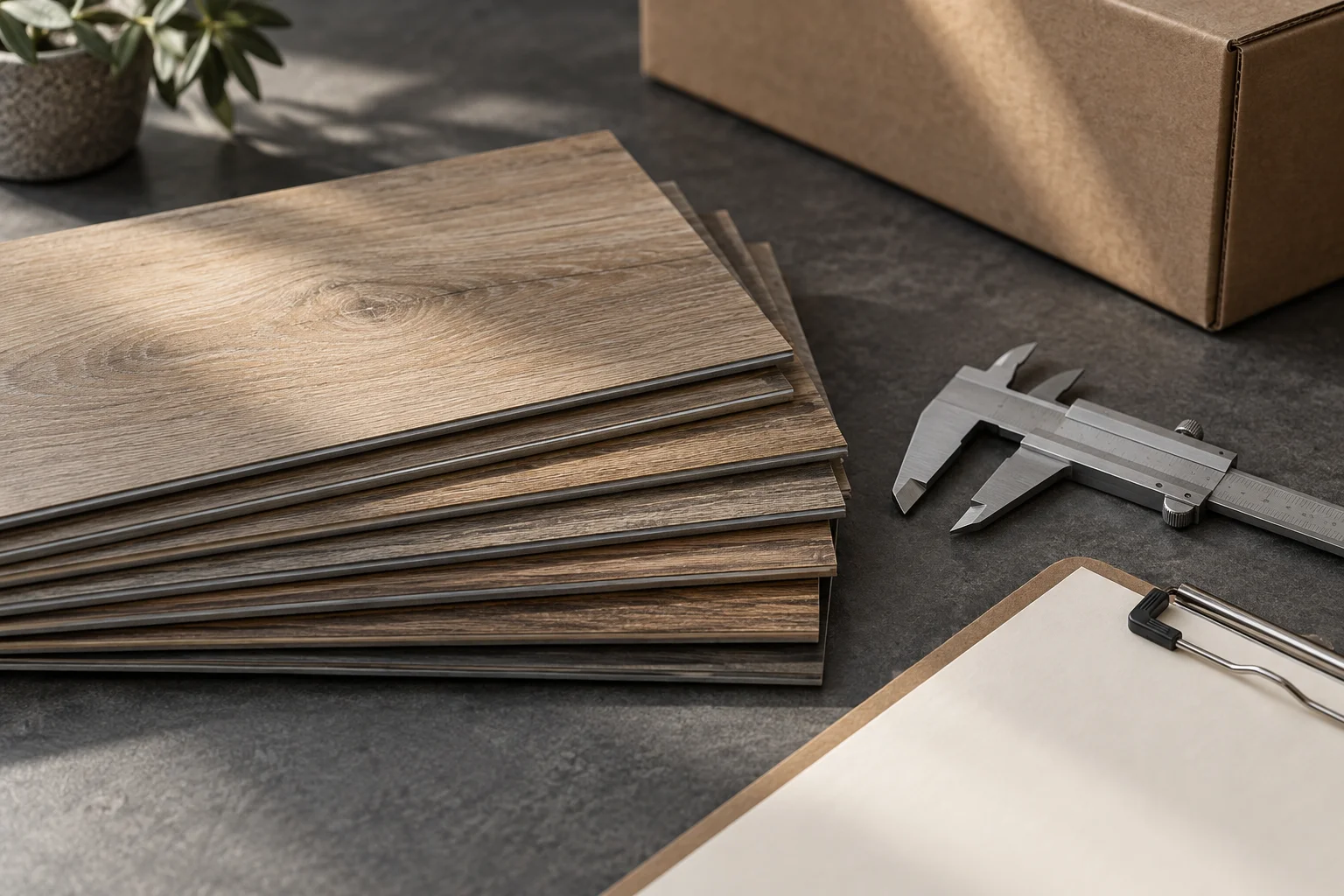
A standard pre-shipment inspection on SPC catches wrong counts and cosmetic faults. The expensive failures are a thinner wear layer, a changed core recipe, a weak click and colour drift between pallets. Write those checks into the brief, with numbers, before the visit. Treat a wear layer below the contracted minimum as critical, not major. Book at 80% packed and keep the release decision with the buyer.
A generic inspection checklist is built for cartons, not floors. Add wear layer, board weight, a test floor and cross-pallet colour checks.
A defect count is not a decision. Where the defects sit, and what they cost after installation, decides a borderline lot.
Most ways to game an inspection depend on the factory choosing what the inspector sees. Take that choice away.
Most inspection firms run SPC through the same final random inspection they use for any boxed product: count the cartons, check the marks, look at the surface, measure a few boards. That catches the cheap problems. The problems that cost you a container show up after the floor is installed, and a generic checklist rarely looks for them.
This guide is about closing that gap. It assumes you know what a PSI is and have booked one before.
Which checks catch the expensive failures?
The question to ask of every line on the checklist is: if this goes wrong and nobody sees it, what does it cost me? Here is how we rank the common checks.
| Check | What it catches | Cost if missed | Our rating |
|---|---|---|---|
| Wear layer cross-section on production boards | A thinner wear layer than contracted | The warranty you sold is no longer true; the defect is invisible on arrival | Essential |
| Board weight against the approved lot | A changed core recipe or more filler | Brittle click, movement, a product that is not the one you approved | Essential |
| 3 × 3 test floor from different pallets | Weak or badly milled click, ledging, gaps | Installer callbacks and claims | Essential |
| Colour and gloss across pallets, against the master board | Two production runs mixed into one order | Shade bands across a room, often found by the end customer | Essential |
| Total thickness and squareness | Out-of-tolerance boards | Fit problems; usually also visible to an installer | Useful |
| Pad present and bonded | Missing or loose underlay | Noise and comfort complaints | Useful |
| Pallet stability, straps, moisture | Damage in transit | Usually a freight claim, not a product claim | Useful |
| Carton print, label layout, barcode position | Cosmetic packaging errors | Low, unless a retailer rejects on labels | Box-ticking for most buyers |
The first four are where we would put most of the inspector’s day. Notice that none of them is on a generic consumer-goods checklist by default. If you do not ask, you usually do not get them.
The wear layer and board weight checks matter most because “good sample, worse bulk” is the specific fear buyers name, and both are hidden. A factory that cuts cost after the sample is approved has two quiet places to do it: the wear layer film and the core mix. Neither shows on a surface check.
What goes in the brief?
An inspector can only fail what you have written down. “Good quality” cannot be inspected; a number with a tolerance can. Send one controlled pack, with a revision date, at least three working days before the visit:
- Purchase order with SKUs, decor codes and quantities per decor
- Signed specification with tolerances: total thickness, wear layer minimum, plank size, bevel, pad, click system
- Board weight of the approved lot, with the tolerance you accept
- Golden sample photos under daylight-equivalent light, and who holds the sealed physical sample
- Packing list: planks per carton, cartons per pallet, marks and labels
- The sampling plan, the defect classes and the borderline rule (all below)
- A factory contact who can open cartons and cut a board on the day
The spec itself should be frozen when you approve the sample, not when the goods are packed. Our guide on turning a sample into a repeatable specification covers that step.
When should the inspection happen?
At 80% or more produced and packed, before you pay the balance. Earlier, the inspector samples whatever exists, which may be the first and best run. Later, there is no time to sort or rework before the vessel cut-off.
Sampling: the numbers, and the change we would make
Most inspections use ISO 2859-1 / ANSI Z1.4 at general inspection level II, with AQL 2.5 for major and 4.0 for minor defects. That default is reasonable. For lot sizes common on SPC orders:
| Lot size (cartons) | Code letter | Sample size | Major AQL 2.5: accept / reject | Minor AQL 4.0: accept / reject |
|---|---|---|---|---|
| 1,201 – 3,200 | K | 125 | 7 / 8 | 10 / 11 |
| 3,201 – 10,000 | L | 200 | 10 / 11 | 14 / 15 |
| 10,001 – 35,000 | M | 315 | 14 / 15 | 21 / 22 |
Two changes we would make to the default.
Count planks, not just cartons. Agree whether the sampling unit is the carton or the plank. Measuring several planks from each sampled carton gives far more data and is how mixed runs inside one carton get found.
Move the hidden failures out of the count. Under AQL, a defect only fails the lot when enough of them pile up. That is fine for a scratch. It is wrong for a wear layer below the contracted minimum, because one measured board that is thin usually means the whole run used the same film. We would class it as critical: one confirmed finding fails the lot. The same goes for wrong decor or a board weight clearly outside the agreed tolerance.
| Class | Examples on an SPC order | Decision |
|---|---|---|
| Critical | Wrong decor or construction; wear layer below minimum; weight outside tolerance; boards that will not lock | Lot fails on one confirmed finding |
| Major | Broken locking profile, ledging beyond the limit, delamination, thickness out of tolerance | Counted against AQL 2.5 |
| Minor | Small surface marks visible only up close, carton print errors | Counted against AQL 4.0 |
How factories game inspections, and how to stop it
We are not saying most factories do this. But the ways it is done are well known, and every one of them depends on the factory controlling what the inspector sees.
- Pre-selected cartons. The best cartons sit at the front of the stack. Fix: the inspector picks cartons at random from across pallets, and the report says which pallets were opened.
- Showroom boards for the wear layer. A board handed over for the cross-section is not a sampled board. Fix: cut only boards the inspector pulled from sampled cartons.
- Inspecting the good run. The order is not fully packed and the inspected part is the first, cleanest run. Fix: book at 80% packed or later, and ask for the production run numbers on every pallet.
- Swapping after inspection. Cartons that passed are not the ones that get loaded. Fix: on a first order, add loading supervision and a seal number photo. Agree the scope with our pre-shipment inspection team.
- Pressure on the inspector. Buyers on public forums describe factories giving local inspectors small tips. Fix: pay a firm, not a person; never pay into a personal bank account; ask for photos with timestamps for every finding.
- The agent who also inspects. If the person who earns a commission on the order also signs the inspection, they are paid to pass it. Fix: keep the two roles separate.
Your own inspector or a third party?
There is no right answer for every buyer. This is how we see the trade-offs.
| Option | Strength | Weakness | When we would use it |
|---|---|---|---|
| General third-party firm | Independent of the factory; published day rates (V-Trust lists USD 268 per man-day in Vietnam, October 2026) | Generic checklist; the flooring checks above only happen if your brief asks for them | Repeat orders with a stable factory and a good brief |
| Your own staff or a buying agent | Knows your product and your customer | May not be independent; an agent paid by order value has a conflict | Only when they do not earn on the order, and with a written brief |
| Flooring-specific inspection | Checks built around SPC failures from the start | Fewer providers, and flooring-specific prices are rarely published | First orders, new factories, new constructions, or after a failed lot |
To be clear about our own position: we offer pre-shipment inspection as one of our buyer services, paid by the buyer only. Whoever you use, the brief matters more than the logo on the report.
On cost: a one man-day PSI is a small share of the value of a full SPC container. The case for skipping it is weakest on exactly the order where buyers most often skip it: the small first order with a factory they have not used before.
Worked example: the lot that fails by one
You order 4,000 cartons. That is code letter L: 200 cartons sampled, majors accepted up to 10, rejected at 11. The report comes back with 11 majors: 9 cases of ledging above your limit and 2 broken tongues. Wear layer and weight are within spec. The vessel leaves in six days.
The count says fail. The useful question is where the defects sit.
- If the 9 ledging cases come from one or two pallets of one production run, the problem is probably local. We would ask the factory to sort that run, replace the cartons, and re-inspect that part of the lot before loading.
- If they are spread across many pallets and runs, sorting will not fix it. Ledging spread across the lot points to the milling or the core, not to a few bad boards. We would not ship, and we would ask for the production records before talking about rework.
What we would not do is accept a discount for click defects. The discount is paid once; the installer callbacks and claims arrive later and cost more. A discount can make sense for minor cosmetic faults on a low-grade line. It is the wrong tool for anything that affects installation.
Now flip the example. The same lot passes with 10 majors, but one cross-section shows a wear layer below your minimum. Under the plain AQL count, the lot passes. Under the critical rule above, it fails. That is the reason to write the rule in before the visit: after the report, the factory will point at the pass.
What the inspection does not cover
A PSI checks the goods you ship, not the design of the product. Dimensional stability, curl after heat, residual indentation and static load are ASTM F3261 performance tests and need a laboratory. Check current lab reports for your exact construction before production, and confirm they name the same factory and product. Factory records show which certificates each plant has made public: compare the records for NEO FLOOR, Huali Group Vietnam and ANZ Flooring. Our guide to checking a FloorScore certificate covers how to verify one with the issuer.
If a PSI finding makes you doubt the construction, for example a board weight well off the approved lot, that is the moment to send boards to a lab, not after arrival.
Common mistakes
- Accepting the inspection firm’s default checklist. It is built for cartons. Add the four flooring checks yourself.
- Letting the factory hand over the boards for cutting. The cross-section is only worth something on a sampled board.
- Arguing defect classes after the report. Every hour spent arguing is an hour closer to the cut-off, and the factory knows it.
- Paying the balance before reading the report. That payment is your only leverage on a borderline lot.
- Keeping no evidence. Retain the golden sample, a few unopened cartons and the report photos. Without them a later claim is your word against the factory’s.
Our view
A PSI is only as good as the brief behind it. The checks that protect you on SPC are the hidden ones: wear layer, board weight, the click on a real test floor, colour across pallets. Put numbers on them, class the hidden failures as critical, and take away the factory’s control over which boxes are opened. When a lot fails narrowly, look at where the defects sit before you look at the count, and do not trade a click defect for a discount.
Book a pre-shipment inspection in Vietnam, or start with the factory record of the plant making your order.
Questions buyers ask
Is a PSI worth it on a small first order?
In our view, yes, more than on a large one. A one man-day PSI at published Vietnam rates is a small share of a 20ft SPC container, and a first order with a new factory is where bulk is most likely to drift from the sample.
Can the factory QC report replace an independent inspection?
No. It is useful as a record of what the factory measured, and you should ask for it. But the factory chose the boards and wrote the report. Use it to compare against the inspector, not instead of one.
Should the inspector also supervise loading?
On a first order or after a failed inspection, we would. It confirms that the inspected cartons are the ones going into the container and ends with a seal number photo. Loading supervision is priced separately.
Does a PSI confirm that the flooring was made in Vietnam?
No. A standard PSI checks quality, quantity and packing. Origin needs a separate document check: the factory registration, production records and the certificate of origin for that shipment.
How long do I have to decide after the report arrives?
Usually only days before the vessel cut-off. That is why defect classes, the borderline rule and who pays for re-inspection belong in the contract, not in an email thread after the report.
Sources & further reading
- ASTM F3261: Standard Specification for Resilient Flooring in Modular Format with Rigid Polymeric Core
- RFCI Rigid Core Flooring certification program (SCS), requires ASTM F3261 compliance
- SGS: Final Random Inspection scope and sampling
- Intertek: product quality inspections and final random inspection
- V-Trust: inspection services in Vietnam (published rate per man-day, checked Oct 2026)
- V-Trust: production process and common quality issues for SPC flooring
Authorship, affiliations & disclosure
Prepared by our team from the standards and inspection-firm sources listed. Sampling figures follow the published ISO 2859-1 / ANSI Z1.4 tables; confirm the plan with your inspector. We offer pre-shipment inspection as a separate service.
Corrections & editorial informationContinue exploring.
The reading room
US tariffs on SPC flooring from Vietnam in 2026: what applies today
As of 26 October 2026: the HTS 3918.10 rate, the 12.5% Section 301 duty on Vietnam, the China comparison, AD/CVD, UFLPA and EAPA, with a worked example.
Read the feature
Who owns Vietnam's SPC flooring factories, and is your floor really made in Vietnam?
Vietnamese, Chinese or international? Graded ownership for published Vietnam SPC factory records, and why US origin depends on where the floor is made.
Read the feature
Read the certificate, not the badge.
The company, product, site and dates behind a flooring certificate matter more than the logo on a supplier presentation.
Read the feature