
Buying guide / Order evidence
SPC click licences: what an importer should check
Check 4 links between producer, click technology, territory and cartons. Licensor guidance separates a licence from click-joint quality control.
Short answer
Identify the producing legal entity, the exact click technology and the destination market, then verify the applicable authorisation and carton requirements with the licensor. A company name on a licensee list is a starting point, not an order approval. Keep those checks separate from the measurements and acceptance criteria used to control the quality of the joint.
Match the producing company and technology to the authorisation relevant to your order.
Confirm the licensor’s applicable label and destination requirements before approving cartons.
Keep technology rights separate from process capability and the measured quality of the joint.
What should an SPC click-licence importer check?
Connect four things before approving an order: the producing company, named technology, destination market and applicable carton requirements. Ask for the exact legal producer rather than a group brand. Verify the relevant permission through the licensor’s published route. A sales claim about a familiar click name is not enough to approve the product and packaging.
Proposed importer check; contractual and programme conditions must be confirmed for the actual order.
| Check | Evidence to request | Keep separate from |
|---|---|---|
| Producer | Legal name and relevant licensee record | A parent group’s marketing identity |
| Technology | Exact profile/system and applicable permission | A generic “click flooring” description |
| Destination | Confirmation of relevant territorial conditions | An assumption that every market is included |
| Cartons | Applicable label instructions and approved artwork | A photograph of another order’s cartons |
Technology rights do not replace the wider supplier investigation. Use the Vietnam factory directory to identify the company record, then keep the licence correspondence with your specific purchase file. A directory listing is not a licensor’s approval of an individual order.
What does a licensee listing tell the buyer?
A listing identifies a company within the licensor’s published network. Use it to begin the entity match, then confirm the technology and conditions relevant to the goods you intend to buy. Do not assume that a trading company, sister factory or changed producing entity has the same permission because it uses similar branding.
Välinge’s distributor support page offers help connecting buyers with its network and states that its technologies are subject to patent protection. Its published material does not itself grant a reader permission to use technology or trademarks. Record the actual authorisation relevant to the manufacturing arrangement.
For an i4F technology, use i4F’s official licensing/contact route to ask about the named producer and proposed technology and destination. The page also links its licensee directory. This route does not establish an order’s rights or transfer another licensor’s label rules to i4F.
Ask the supplier to identify who will manufacture the order and who will issue the invoice. If those entities differ, preserve the explanation in the file. Changing the invoicing company should not make the producing company disappear from the technical and licence record.
How should carton labels be checked?
Confirm the licensor’s programme for the product and region before approving artwork or shipment. Unilin’s L2C guidance explains a label programme for flooring using licensed technology, including manufacturer obligations and territorial label distinctions. A correctly named factory and an unlabelled carton are separate questions under that programme; resolve both with the relevant licensor.
The Unilin L2C programme states that applicable products without the instructed labels are considered unlicensed even when made by a licensee. It also says importers and distributors cannot obtain the labels themselves. Do not ask a carton printer to imitate a label or assume a generic logo is equivalent.
Request the approved label placement and applicable instructions with the carton revision. Keep reference photographs from the order being inspected. Label presence alone does not establish authenticity or settle every licence condition, so direct unresolved questions to the licensor rather than giving the buyer an unsupported clearance statement.
Why is ClickControl a separate question from a click licence?
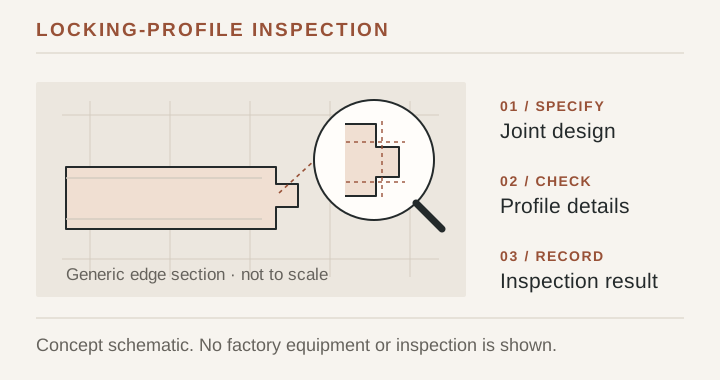
A device used to measure a milled joint answers a production-control question. Permission to use a patented technology answers a rights question. Both can matter, but one does not prove the other. Ask which profile is authorised and how the proposed product is checked, with the acceptance criteria and records attached to its revision.
On 25 June 2024, NEO FLOOR announced a ClickControl agreement in text attributed to Unilin. The announcement concerns a quality-measurement device for locking profiles. It is historical evidence of that announcement, not confirmation of the equipment’s present installation, calibration or use for a later order.
Our NEO FLOOR ClickControl source note documents that announcement. Request the current checking method and lot records from the producer before using it as evidence for a shipment.
What does a worked example of order approval show?
Take an illustrative programme with two proposed factories and one intended destination. Factory A supplies a relevant entity match and order-specific label confirmation. Factory B supplies only a photograph bearing a technology logo. Record the second file as incomplete. This comparison describes evidence quality, not a judgement about any named factory’s licence status.
Hypothetical documents only; A and B are invented producer labels.
| Approval field | Factory A file | Factory B file | Purchasing action |
|---|---|---|---|
| Legal producer | Named and matched | Sales brand only | Obtain the actual producer |
| Technology | Exact system stated | Generic logo | Identify system and permission |
| Destination | Relevant conditions recorded | No confirmation | Ask the licensor for clarification |
| Packing | Order-specific instructions | Another order’s photograph | Hold artwork approval pending evidence |
The next decision is not to rate Factory B as infringing. Obtain the missing information and review it. A missing document in a purchasing file does not establish the legal status of all products made by a company. Keep any allegation out of the public profile unless supported by an appropriate documented finding.
Our view: what belongs in the product-development brief?
We would lock the exact technology and producing entity alongside the approved board construction. Record the relevant licence and carton decisions before production, then agree the joint-checking method separately. A later profile or factory substitution should reopen both the authorisation check and the product acceptance decision instead of inheriting the old file by default.
Our product-development support can coordinate the factory-side specification and follow-up. The licence position belongs with the relevant licensor and the buyer’s advisers. The quality plan should name the measurement method, sample selection and agreed acceptance criteria, rather than treating a technology brand as a guarantee against claims.
Common mistakes: what should the buyer keep separate?
Separate the records that answer permission, manufacturing control and shipment approval questions. The file becomes misleading when evidence for one is copied into the others. Use the corrections below as purchasing controls, with unresolved licence questions referred to the appropriate rights holder. No universal royalty, label cost or permitted territory is assumed here.
Practical controls, not a legal opinion on a specific technology or supplier.
| Mistake | Practical correction |
|---|---|
| Approving a group logo instead of the producer | Match the legal company making the order |
| Treating a measurement device as a patent licence | Keep device records and technology rights separate |
| Copying carton labels from a previous market | Confirm applicable territory and label instructions |
| Calling a missing document proof of infringement | Obtain evidence and a licensor response before concluding |
For the separate question of where the product is manufactured, use the origin-evidence workflow. Rights to a click technology do not establish the origin of a shipment. Keeping those conclusions distinct makes repeat-order changes easier to review without expanding a claim beyond its evidence.
Questions buyers ask
What if inspection stock has cartons from different packing runs?
Record which carton marks and packing runs belong to the inspected order. Ask the producer to explain the mixed stock and obtain any necessary licensor clarification before treating a photograph as the order’s label evidence. This record check does not decide whether the goods infringe.
What if the contract seller differs from the licensed producer?
Record both legal entities and the relationship for this order. Confirm the manufacturing entity and applicable permission with the licensor where needed. Do not assume the seller must hold the same manufacturing licence, or that a relationship transfers rights automatically.
Can we change factory without revisiting the click check?
Recheck the new legal producer and applicable authorisation. Even with a familiar technology name, manufacturing control and carton requirements need to be established for the new order.
Does a patent licence replace a warranty?
No. Record the contractual warranty and remedies separately. A licence addresses permitted use of technology; it does not settle the buyer’s acceptance criteria or who bears the cost of a defective production lot.
Sources & further reading
Authorship, affiliations & disclosure
Prepared from the licensor and manufacturer sources listed, checked 7 November 2026. The A/B example is illustrative. This buyer workflow is not a legal opinion on an order’s rights or a test of its click joints.
Corrections & editorial informationContinue exploring.
The reading room
How to check the origin of SPC flooring made in Vietnam
Check 4 evidence trails before an SPC order: factory, materials, production and shipment. A buyer workflow grounded in US customs rules.
Read the feature
UFLPA and PVC flooring: trace the materials behind the order
Build a PVC traceability file for a US flooring order using CBP guidance updated in 2026. Separate final-plant audits from upstream evidence.
Read the feature
US tariffs on SPC flooring from Vietnam in 2026: what applies today
As of 26 October 2026: the HTS 3918.10 rate, the 12.5% Section 301 duty on Vietnam, the China comparison, AD/CVD, UFLPA and EAPA, with a worked example.
Read the feature